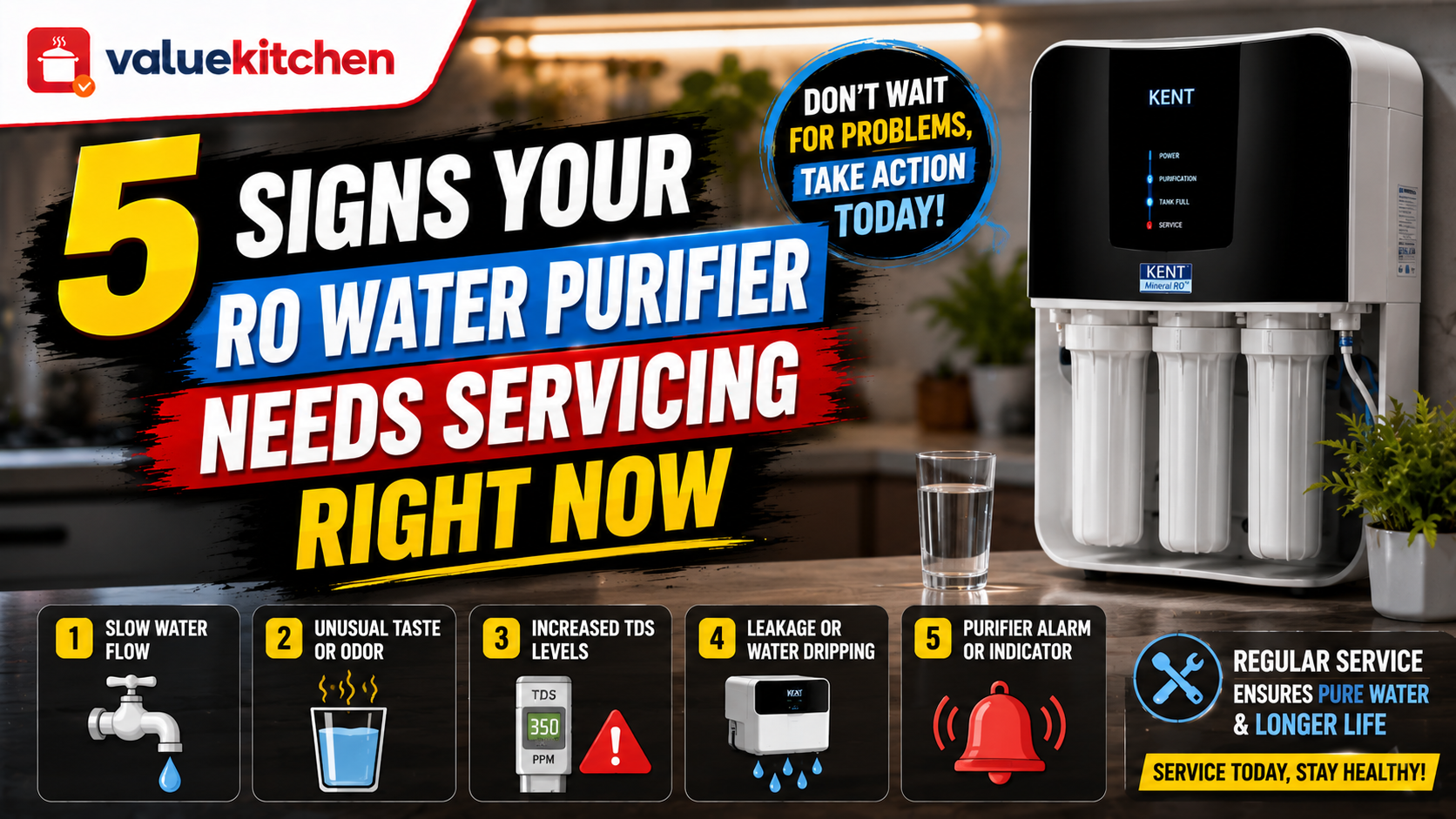
5 Signs Your RO Water Purifier Needs Servicing Right Now (And What Each Sign Actually Means)
Some links on this page are affiliate links. We may earn a commission at no extra cost to you.
An RO water purifier does not announce when it is failing. The water keeps coming out clear, you keep drinking it, and by the time something looks visibly wrong, the filters may have been exhausted for weeks. Most servicing issues show up as subtle changes in taste, flow, or behavior long before the water looks contaminated.
These 5 signs are your purifier’s way of telling you it needs attention. Each one points to a specific problem, and knowing what it means helps you act before it becomes a bigger issue.
- 5 Signs at a Glance
- Sign 1: Water Tastes Metallic or Has a Strange Smell
- Sign 2: Water Flow Has Become Very Slow
- Sign 3: Unusual Noise or Non-Stop Running
- Sign 4: Water Looks Cloudy or Has Visible Particles
- Sign 5: Service Indicator Light or Constant Beeping
- How Often Should You Service an RO Purifier?
- Frequently Asked Questions
5 Signs at a Glance
| # | Sign | Likely Cause | Urgency |
|---|---|---|---|
| 1 | Water tastes or smells off | Exhausted carbon filter or RO membrane | High |
| 2 | Very slow flow from the tap | Clogged pre-filter or membrane | Medium-High |
| 3 | Unusual noise or non-stop running | Pump issue or faulty shut-off valve | Medium-High |
| 4 | Cloudy water or visible particles | Broken membrane or post-filter failure | High |
| 5 | Service indicator light / constant beeping | Filter life exhausted or sensor trigger | High |
Sign 1: Water Tastes Metallic, Salty, or Has a Strange Smell
What it means: The carbon pre-filter or post-carbon filter has likely crossed its service life. These filters remove chlorine, organic compounds, and odor-causing substances. When they are exhausted, these contaminants pass through into your drinking water, changing the taste and smell.
A metallic taste can also indicate that the RO membrane is no longer removing dissolved solids effectively, allowing minerals like iron or manganese to pass through in higher concentrations than normal.
How to verify: Buy a TDS meter (available for under Rs. 300 online). Your purified water TDS should typically be between 50 and 150 ppm for most Indian municipal water sources. If the TDS is above 250 ppm, the membrane needs replacement. If the TDS looks fine but the smell persists, the carbon filter is the likely culprit.
What to do: Call your purifier’s service center immediately. Do not continue drinking water with an off taste. A filter change takes less than an hour for most models.
Urgency: High. Taste and odor changes mean the purification is already compromised.
Sign 2: Water Flow From the Purifier Tap Has Become Very Slow
What it means: Slow flow almost always points to one of two things: a clogged sediment pre-filter, or a partially blocked RO membrane. The sediment filter catches sand, rust, and particulate matter from the incoming water supply. When it gets saturated, it restricts water flow to the membrane.
A partially clogged RO membrane reduces the rate at which water permeates through and fills the storage tank. If the storage tank fills slowly and the tap output feels weaker than before, the membrane may be due for replacement.
How to verify: A new purifier of the same model takes a certain number of hours to fill its tank. If your tank is taking significantly longer than it used to, slow flow is the likely cause. You can also check if the incoming water pressure to your house has dropped, as low inlet pressure also causes slow purification.
What to do: Start with the sediment pre-filter. It is usually the cheapest and most frequently needed replacement part (every 3 to 6 months, depending on water quality in your area). If changing the pre-filter does not improve flow, the membrane may need replacement.
Urgency: Medium-High. Slow flow means the purification process is under strain and may become ineffective over time.
Sign 3: The Purifier Makes Loud Noises or Runs Without Stopping
What it means: Two different issues can cause this. Unusually loud humming or vibrating sounds from the pump indicate that the pump is working harder than normal, usually because of a clogged pre-filter or membrane. A strained pump draws more power and wears out faster.
If the purifier runs continuously without shutting off, even when the storage tank is full, the automatic shut-off valve has likely failed. The shut-off valve controls the flow of water to the membrane once the tank reaches capacity. A faulty valve means the system keeps running, wasting water and stressing the pump.
How to verify: Listen to how your purifier sounds compared to when it was new. Most RO purifiers run quietly and shut off automatically within a few hours of filling. Continuous running for more than 4 to 6 hours straight is a clear sign that the shut-off valve needs attention.
What to do: A continuously running purifier needs a technician visit. The shut-off valve replacement is a low-cost fix, but it requires the right part for your model. Do not ignore it, as extended motor running without a shutoff shortens the pump’s life significantly.
Urgency: Medium-High. Left unchecked, a non-stop running purifier leads to pump failure, which is the most expensive repair on any RO unit.
Sign 4: Water Looks Cloudy or Has Visible Particles
What it means: Cloudy or visibly particulate water coming from a purifier that was previously clear is a serious sign. It usually means the post-carbon or UV filter has failed, or in rarer cases, the RO membrane has developed a tear or crack. A damaged membrane allows unfiltered water to bypass the purification stages and reach the storage tank.
Sometimes cloudiness is caused by air bubbles after a service visit or after the purifier was switched off for an extended period. Air bubble cloudiness clears within a minute when you run the tap. If the cloudiness persists, the cause is filtration failure.
How to verify: Fill a clear glass and let it sit for 2 minutes. Air bubble cloudiness clears from the bottom up within a minute. Persistent cloudiness or visible white/grey particles that settle at the bottom indicate a filtration problem.
What to do: Stop drinking the water immediately. Call for service. Cloudiness from filtration failure is a health risk. This is not a situation to delay.
Urgency: High. Stop use and call the service immediately if cloudiness persists after the glass sits for 2 minutes.
Sign 5: The Service Indicator Light Is On, or the Purifier Keeps Beeping
What it means: Most modern RO purifiers from brands like Kent, Aquaguard, AO Smith, and Livpure have filter life indicators or service reminders built in. These tracks either the volume of water purified or the time elapsed since the last service. When the indicator lights up or the purifier starts beeping, the system has crossed a threshold that the manufacturer set for safe operation.
Some purifiers also have UV lamp failure indicators. If the UV lamp alert triggers, the purifier may still be passing water through, but without UV sterilization, meaning bacteria and viruses are not being neutralized.
How to verify: Check your purifier’s user manual for what each indicator light or beep pattern means. Different models use different alert systems. A red light on Kent models usually means filter service is due. A flashing UV indicator on Aquaguard or AO Smith models usually means the UV lamp has failed or needs replacement.
What to do: Do not ignore the indicator and hope it goes away. Book a service visit with your brand’s authorized service center. Most service reminders are set well in advance of actual failure, giving you a reasonable window to act. Delaying by more than 2 to 4 weeks after the indicator triggers is not advisable.
Urgency: High. Service indicators exist for a reason. Treat them as you would a check engine light in a car.
How Often Should You Service an RO Purifier?
| Component | Typical Replacement Interval | Signs It Needs Changing |
|---|---|---|
| Sediment pre-filter | Every 3 to 6 months | Slow flow, visible brown discoloration on the filter |
| Carbon pre-filter | Every 6 months | Chlorine or chemical smell in purified water |
| RO membrane | Every 2 to 3 years | High TDS in output, slow flow, taste change |
| Post-carbon / polishing filter | Every 12 months | Taste or odor in purified water |
| UV lamp | Every 12 months | UV indicator light, bacteria detected in water |
| UF membrane | Every 2 to 3 years | Cloudy output, particles in water |
These are general intervals. Actual replacement frequency depends on your incoming water quality and daily water consumption. High TDS or sediment-heavy supply water shortens filter life significantly.
Frequently Asked Questions
How do I know if my RO membrane needs replacement?
Use a TDS meter to measure purified water output. A healthy RO membrane typically reduces TDS by 85 to 95% from inlet water. If your purified water TDS is above 250 ppm or the reduction is below 85%, the membrane is likely exhausted and needs replacement.
Is it safe to drink water from an RO purifier that has not been serviced in over a year?
It depends on the model and your water source. Most RO purifiers are designed for annual servicing. An unserviced purifier may still reduce some contaminants, but exhausted carbon filters let chlorine and organics through, and an overdue RO membrane lets TDS rise. If servicing is overdue, get it done before relying on the water.
Why is my RO purifier wasting so much water?
RO purification naturally wastes water as reject water (brine). A healthy RO ratio is typically 1:3 or better (1 litre purified for every 3 litres rejected). If your system is wasting significantly more, the membrane or reject ratio valve may need adjustment or replacement.
How much does an RO service call cost in India?
A basic service visit (cleaning, pre-filter check) from authorized service centers typically costs Rs. 300 to Rs. 600. Filter replacements add Rs. 500 to Rs. 1,500, depending on which filters need changing. Full membrane replacement costs Rs. 1,000 to Rs. 3,000, depending on the model and brand.
Can I replace RO filters myself without a technician?
For some models, yes. Sediment and carbon pre-filter cartridges on many models are designed for easy user replacement with a filter wrench. However, RO membrane replacement and UV lamp changes typically require a technician to ensure correct installation and re-pressurization of the system.