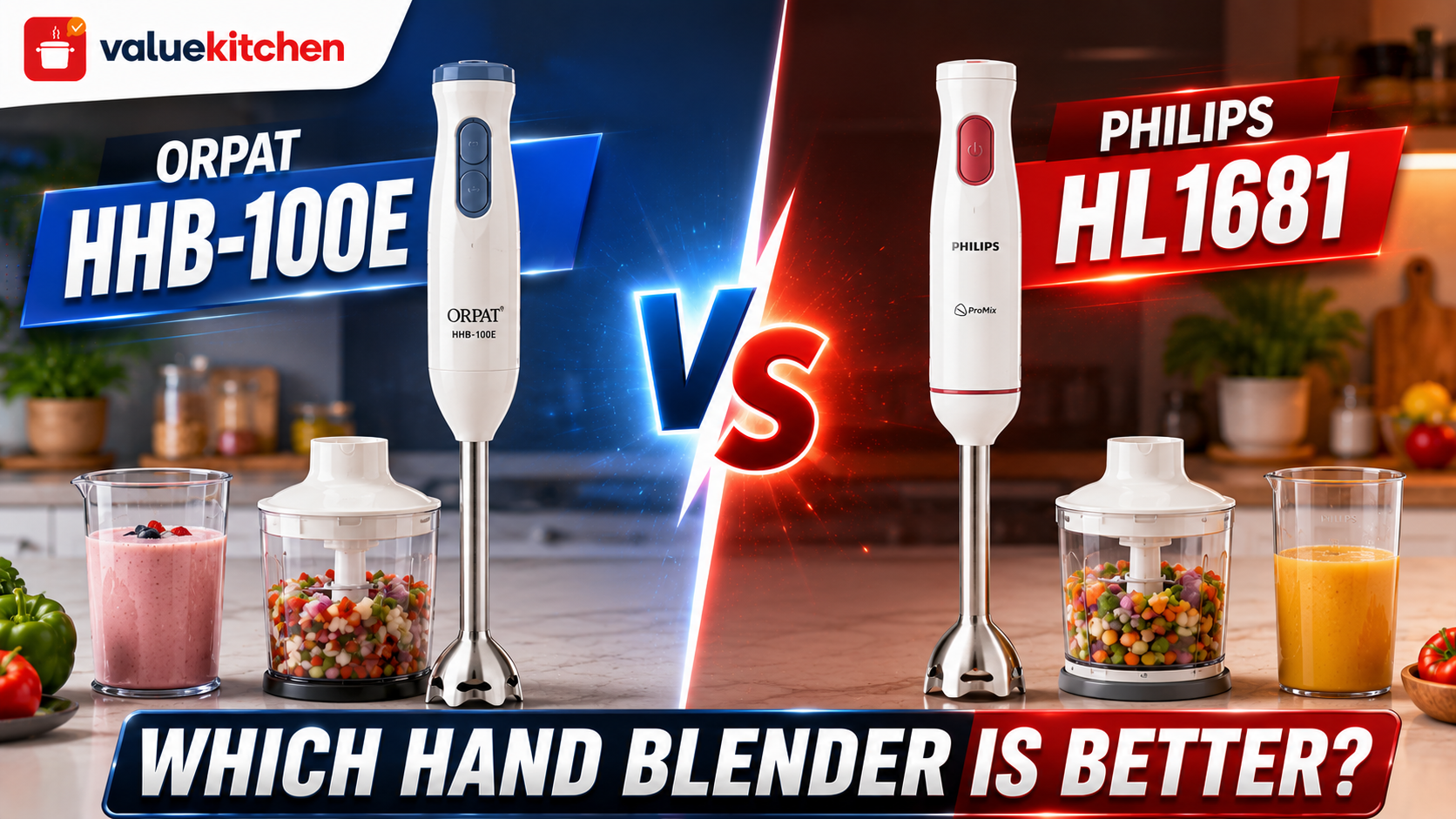
Orpat HHB-100E vs Philips HL1681 Hand Blender: Budget vs Premium
Some links on this page are affiliate links. We may earn a commission at no extra cost to you.
The Orpat HHB-100E costs Rs. 799. The Philips HL1681 costs Rs. 1,749. Both are hand blenders with strong review counts on Amazon India. The Rs. 950 difference between them is significant, and whether that gap is worth it depends entirely on how you cook. This comparison gives you a straight answer.
Quick Comparison: Orpat HHB-100E vs Philips HL1681
| Feature | Orpat HHB-100E | Philips HL1681 |
|---|---|---|
| Price | Rs. 799 | Rs. 1,749 |
| Power | 250W | 300W |
| Blending arm | Stainless steel | Rust-free stainless steel |
| Speed control | Single speed | Single trigger |
| Anti-splash blades | No | Yes |
| Wall bracket | No | Yes |
| Warranty | 1 year | 2 years |
| Ratings | 4.2/5 (24,800+ reviews) | Verified buyers |
| Amazon’s Choice | Yes | No |
Orpat HHB-100E , Rs. 799

Orpat is an Indian brand with decades of experience in small appliances and a strong service network. The HHB-100E is their most popular hand blender, earning Amazon’s Choice with over 24,800 ratings and 3,000+ units sold in the past month. At 250W, it blends smoothies, tomato soups, soft chutneys, and batters without difficulty.
The stainless steel blending arm detaches in one click for easy cleaning. The ergonomic grip reduces hand fatigue during longer blending sessions. For the price, this is one of the most reliable hand blenders available in India, backed by the kind of review volume that removes most of the buying risk.
Where it falls short is in power and feature set. There is no variable speed, no anti-splash blade guard, and no storage solution included. For basic daily blending that is no issue. But if you blend soups directly in a pot on the stove or need texture control, you notice the limitations.
- Affordable at Rs. 799 with Amazon’s Choice badge
- 24,800+ verified ratings reduce buying risk significantly
- Stainless steel arm detaches in one click for easy cleaning
- Handles smoothies, soups, and soft chutneys reliably
- No anti-splash blade guard for hot soup blending
- Single speed only, no texture control
- Only 1-year warranty vs Philips 2-year coverage
- No wall bracket for counter storage
Philips HL1681 , Rs. 1,749

The Philips HL1681 is built for cooks who blend frequently and want a product that lasts. The 300W motor with a rust-free stainless steel arm handles soups, smoothies, chutneys, and whipped cream consistently. The ergonomically designed blades reduce liquid splatter, which is a real problem with cheaper hand blenders when you blend hot soups directly in a pot.
The wall bracket for storage keeps your counter clean and the blender accessible. The 2-year warranty and Philips service centres across India make ownership hassle-free. The build quality is noticeably better than budget options, and the single-trigger operation is smooth and responsive.
The gap over the Orpat comes down to three things: anti-splash blade design, 2-year warranty instead of 1, and the Philips service and reliability track record. For a household that blends every day, those extras justify the price jump.
- Anti-splash blade design keeps hot soup blending clean
- 300W motor handles tougher ingredients more consistently
- Wall bracket included for neat counter storage
- 2-year warranty with Philips service centres across India
- Costs Rs. 950 more than the Orpat HHB-100E
- Overkill if you blend only 2 to 3 times a week
- Does not include a chutney jar for dry grinding
Head-to-Head: Key Differences That Matter
Power
The Philips is 50W more powerful at 300W vs 250W. In everyday use, the difference is noticeable mainly when blending fibrous vegetables, thick batters, or frozen fruit. For soft soups and smoothies, both perform well. If you blend harder ingredients regularly, the extra wattage matters.
Anti-Splash Blade Design
This is the most underrated difference between the two. Blending hot soup directly in the pot without a splash guard creates a mess. The Philips HL1681 has ergonomically designed blades that minimize this. The Orpat does not have this feature. If you blend soups on the stovetop, the Philips is the safer, cleaner choice.
Warranty
The Orpat gives 1 year. The Philips gives 2 years. For a kitchen appliance used daily, an extra year of warranty coverage is a tangible advantage. Philips also has a wider and more responsive service network across India compared to Orpat.
Price
The Rs. 950 difference is real. If you blend 2-3 times a week for light tasks, the Orpat at Rs. 799 is entirely adequate and the extra spend on Philips is not justified. If you blend daily for a family of 4 or more, the Philips pays back through durability and features within a few months of use.
Which One Should You Buy?
Choose the Orpat HHB-100E (Rs. 799) if: You blend occasionally, cook for 1-2 people, want a budget-friendly reliable option, or are buying a hand blender for the first time.
Choose the Philips HL1681 (Rs. 1,749) if: You blend every day, cook for 3 or more people, blend hot soups in a pot, want 2-year warranty coverage, or prefer a premium brand with strong after-sales support.
Use Cases at a Glance
| Use Case | Orpat HHB-100E (250W) | Philips HL1681 (300W) |
|---|---|---|
| Smooth tomato soup | Yes | Yes |
| Soft vegetable purees | Yes | Yes |
| Banana or soft fruit smoothie | Yes | Yes |
| Hot soup blending in a pot on stove | Messy, no splash guard | Clean, anti-splash blades |
| Frozen fruit or thick yogurt smoothie | Struggles at high density | Handles more cleanly |
| Coconut milk extraction | Yes | Yes |
| Whipping light cream | Works | Faster, cleaner result |
| Dry grinding spices or chutneys | No | No (use a mixer grinder) |
Both hand blenders are designed for wet blending and direct-in-pot tasks. Neither replaces a mixer grinder for dry grinding or fine wet grinding for idli-dosa batter. The table above shows where the Philips HL1681 pulls ahead: primarily in tasks involving high heat, splash risk, or very dense ingredients. For households that do basic blending 2 to 3 times a week, the Orpat handles all of the above with only minor practical limitations, and the Rs. 950 difference is better spent elsewhere. For households that blend every day or cook soups frequently, the Philips earns its premium back in performance and daily convenience.
Frequently Asked Questions
Is 250W enough for daily blending in an Indian kitchen?
Yes, for most everyday tasks. Soft vegetables, cooked soups, smoothies, and light chutneys blend fine at 250W. For raw fibrous vegetables, large batches of thick batter, or tougher ingredients, 300W to 400W handles the job more comfortably.
Does Philips HL1681 come with a chutney jar?
No. The HL1681 is a stick blender designed for blending directly in bowls and pots. For grinding dry chutneys, you still need a mixer grinder jar. Hand blenders handle wet grinding and blending tasks only.
Which is better for making smoothies in India, Orpat or Philips?
Both handle smoothies well. For soft fruit smoothies, the Orpat is perfectly adequate. For frozen fruit or thick yogurt-based smoothies, the Philips 300W motor handles it more cleanly. The anti-splash design also keeps the blending area tidier for thicker mixes.
Can I use a hand blender to make idli or dosa batter?
A hand blender can blend pre-soaked rice and lentils but it does not achieve the fine smooth texture that a wet grinder or mixer grinder does. For occasional small batches, it works acceptably. For regular large-volume batter, a dedicated mixer grinder is the better tool.
Also read: AGARO Elite vs AGARO 400W electric chopper , if chopping dry ingredients like onions, garlic, and spice pastes is your primary task. | 5 quick Indian chutneys you can make in 5 minutes