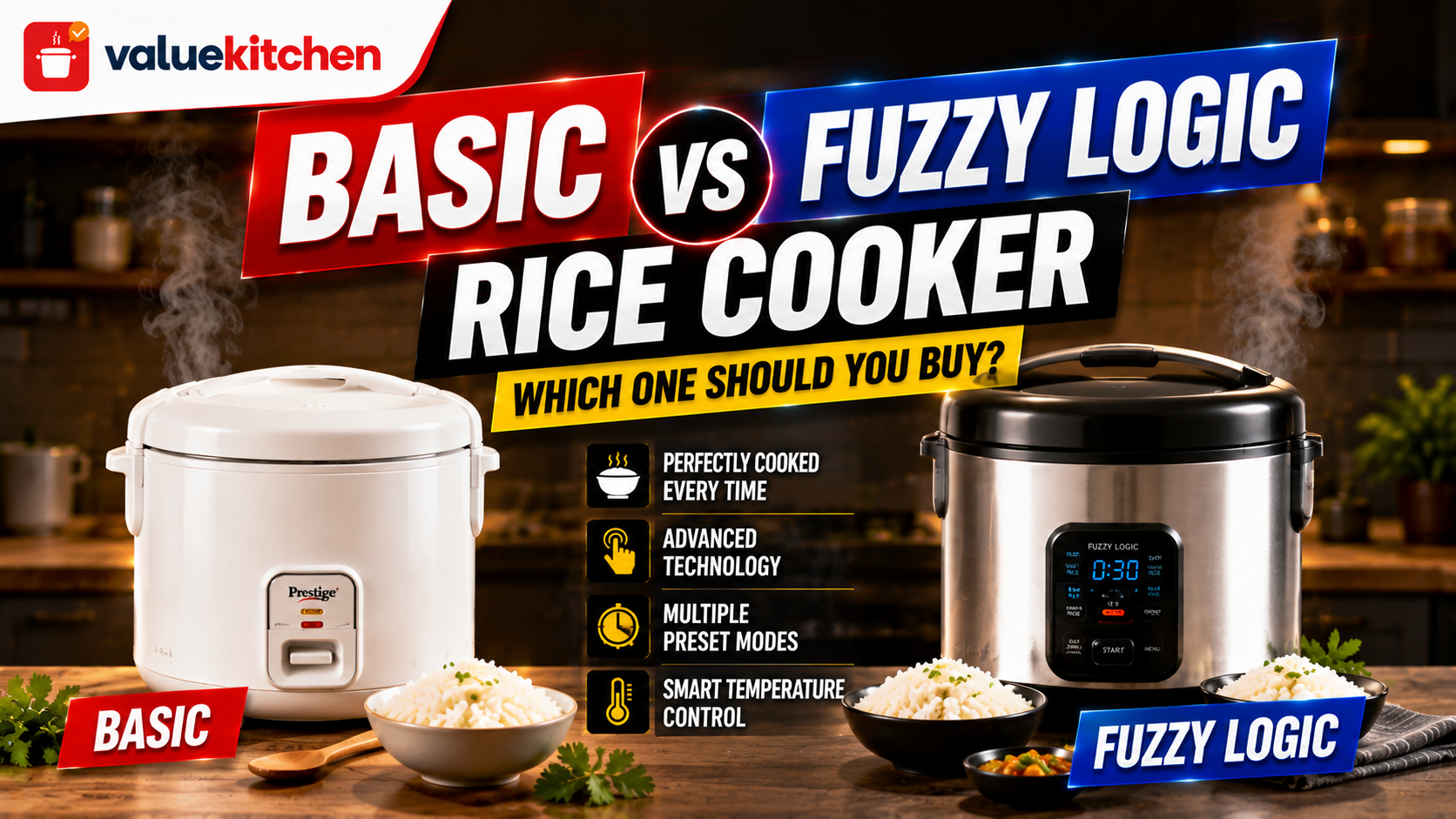
Basic vs Fuzzy Logic Rice Cooker: Which One Should You Buy?
Some links on this page are affiliate links. We may earn a commission at no extra cost to you.
Walk into any electronics store, and you will see two types of rice cookers: a simple Rs. 1,500 model with an on/off switch, and a Rs. 6,000 model with a digital display, multiple cooking modes, and something called “fuzzy logic.” The price difference is significant. This comparison explains exactly what fuzzy logic means, how it differs from a basic cooker, and which one makes more sense for your specific cooking needs.
Quick Links: Pigeon Joy 1.8L Basic Rice Cooker | Panasonic SR-WA22H Automatic Rice Cooker
What is a Basic Rice Cooker?
A basic rice cooker works on a simple principle. You add rice and water, press the switch, and the cooker heats up. When all the water evaporates, and the temperature at the bottom rises above 100 degrees C, a thermostat detects the change and flips from “cook” to “warm.”
That is the entire mechanism. No sensors, no adjustments. The ratio of rice to water and the quality of your rice determine the outcome. If you add the right water ratio, you get good rice. If you add too little or too much, the result reflects that.
Basic rice cookers work best for: White rice cooked with a consistent water ratio, everyday cooking where the same type of rice is used each time.
What is Fuzzy Logic?
Fuzzy logic is a microprocessor-based control system that allows the cooker to make adjustments during cooking. Instead of a simple on/off thermostat, fuzzy logic cookers use sensors to monitor temperature at multiple points and adjust heat throughout the cooking process.
A standard thermostat only knows “done” or “not done.” A fuzzy logic system evaluates “slightly undercooked,” “getting close,” “needs more steam,” or “temperature dropped, adding more heat.”
Fuzzy logic rice cookers can adjust for different types of rice, compensate for altitude changes, detect if the lid is not properly sealed, and handle sprouted grains and brown rice modes. They also reduce the mushy-bottom problem that is common in basic cookers.
Side-by-Side Comparison
| Feature | Basic Rice Cooker | Fuzzy Logic Rice Cooker |
|---|---|---|
| Price range | Rs. 1,500 to Rs. 3,000 | Rs. 5,000 to Rs. 15,000+ |
| Cooking modes | Cook / Keep Warm | White, Brown, Sushi, Porridge, Steam, and more |
| Water ratio flexibility | Low, must measure correctly | High, auto-adjusts for variation |
| Rice types supported | White rice primarily | All types, including brown and red rice |
| Consistency | Depends on your water ratio | Consistent across batches |
| Keep warm duration | 2 to 4 hours (basic heating) | Up to 24 hours with intelligent warming |
| Delay timer | Rarely available | Usually included |
| Ease of use | Extremely simple | Simple once set up, more options initially |
| After-sales parts | Easy to find | Brand-specific, harder to source |
Does Fuzzy Logic Make a Difference for Indian Rice?
For everyday white rice like sona masuri, ponni, or short-grain varieties, a basic rice cooker works perfectly well with the right water ratio. Fuzzy logic makes a bigger difference when:
You cook multiple types of rice. If you eat basmati for lunch, brown rice for dinner, and red rice on weekends, fuzzy logic adapts automatically. A basic cooker needs manual water ratio adjustments for each variety.
You cook brown rice regularly. Brown rice needs more water and a longer cooking time. Basic cookers often undercook it or produce uneven results. Fuzzy logic handles this consistently.
You want a delay timer. Fuzzy logic cookers let you set rice to be ready at a specific time. You can add rice in the morning and have it ready when you come home.
Our Recommendations
Best Basic Rice Cooker: Pigeon Joy 1.8L Double Pot (Rs. 2,019)
For families of 3 to 4 who cook white rice daily, the Pigeon Joy 1.8L is the best value in the basic category. Two cooking bowls, auto keep-warm, and a strong Amazon rating. See our full list: 5 Best Electric Rice Cookers Under Rs. 2,000 in India.
- Simple one-button operation, zero learning curve
- Auto keep-warm switches on after cooking completes
- Two cooking bowls included for the price
- Affordable at Rs. 2,019 with strong Amazon ratings
- No water ratio adjustment or smart sensing
- Inconsistent results if you vary the rice type
- Keep-warm quality drops after 2 to 4 hours
- Not suited for brown rice or mixed grains

Best Fuzzy Logic Rice Cooker: Panasonic SR-WA22H 5-Cup Automatic Rice Cooker (Rs. 3,290)
The Panasonic SR-WA22H is one of the most popular rice cookers in India for households that want automatic adjustment without paying for a full fuzzy logic system. The 5-cup capacity is ideal for families of 4. If you want a true multi-mode fuzzy logic model, the Panasonic SR-DF series (Rs. 5,500 and above) offers white, brown, and multi-grain modes with auto heat adjustment.
- Consistent results without precise water measuring
- Handles white, brown, and basmati varieties reliably
- Superior keep-warm maintains quality for longer
- Panasonic parts and service available across India
- Costs more than basic cookers in the same size range
- Overkill if you only cook one type of white rice
- Brand-specific parts can be harder to source locally

Which One is Right for You?
Buy a basic rice cooker if you cook the same type of white rice every day, your budget is under Rs. 3,000, and you are comfortable measuring water accurately.
Buy a fuzzy logic or advanced rice cooker if you cook different rice varieties regularly, you eat brown rice or mixed grain rice, you want consistent results without measuring water precisely, or your budget allows Rs. 3,000 to Rs. 8,000.
Also read: 5 Best Electric Rice Cookers Under Rs. 2,000 in India
Keep Warm Performance: A Key Practical Difference
The keep-warm feature matters significantly in Indian kitchens where rice is cooked 30 to 90 minutes before serving. A basic rice cooker switches to keep-warm by maintaining a low constant heat. After 1 to 2 hours, this can dry out the top layer of rice and leave a slightly overcooked bottom layer. Fuzzy logic cookers use periodic heat cycling in keep-warm mode rather than constant low heat. This maintains moisture and texture for up to 12 hours without significant degradation, which is a real advantage for households that cook in the morning and eat in shifts.
Delay Timer: Cook Rice Without Being in the Kitchen
The delay timer is the most underrated differentiator between basic and fuzzy logic cookers. Fuzzy logic cookers like the Panasonic SR-WA22H allow you to set rice to begin cooking at a scheduled time. You can add soaked rice the night before and set it to be ready when you wake up. Basic rice cookers do not offer this , they start cooking immediately when switched on and have no timer function.
Electricity Use: Basic vs Fuzzy Logic Compared
Basic rice cookers typically use 400W to 700W during active cooking. Fuzzy logic cookers use a similar range during cooking but are more efficient in keep-warm mode because they cycle heat rather than maintaining constant output. For a household that keeps rice warm for 4 to 5 hours daily, a fuzzy logic cooker can save approximately Rs. 300 to Rs. 600 per year in electricity compared to a basic cooker running constant keep-warm. Over the 5 to 7-year ownership period of a typical rice cooker, the electricity savings partially offset the higher upfront cost of the fuzzy logic model, in addition to the time and consistency benefits.
Frequently Asked Questions
Is fuzzy logic the same as an induction rice cooker?
No. Fuzzy logic refers to the control algorithm. Induction refers to the heating method. A rice cooker can have fuzzy logic with conventional heating or with induction heating.
Can a basic rice cooker cook brown rice?
A basic rice cooker can cook brown rice, but the results are often inconsistent. Brown rice needs more water and a longer cooking time. You may need to run the basic cooker through two cycles.
Do fuzzy logic cookers save electricity?
Fuzzy logic cookers are often more energy-efficient because they use just enough heat for each cooking stage. The difference is small for everyday cooking.
What is the best fuzzy logic rice cooker brand in India?
Panasonic and Zojirushi are the two most trusted brands available in India. For budget fuzzy logic options, look at the Panasonic SR-DF series starting at around Rs. 5,500.
How important is a keep-warm function?
Very important for Indian kitchens. Food is often cooked before mealtime and needs to stay warm. A basic cooker’s keep-warm is fine for 1 to 2 hours. Fuzzy logic cookers maintain quality for up to 12 to 24 hours.