Philips HD4938 vs Bajaj Majesty ICX 7: Which Induction Cooktop Should You Buy?
Some links on this page are affiliate links. We earn a commission at no extra cost to you.
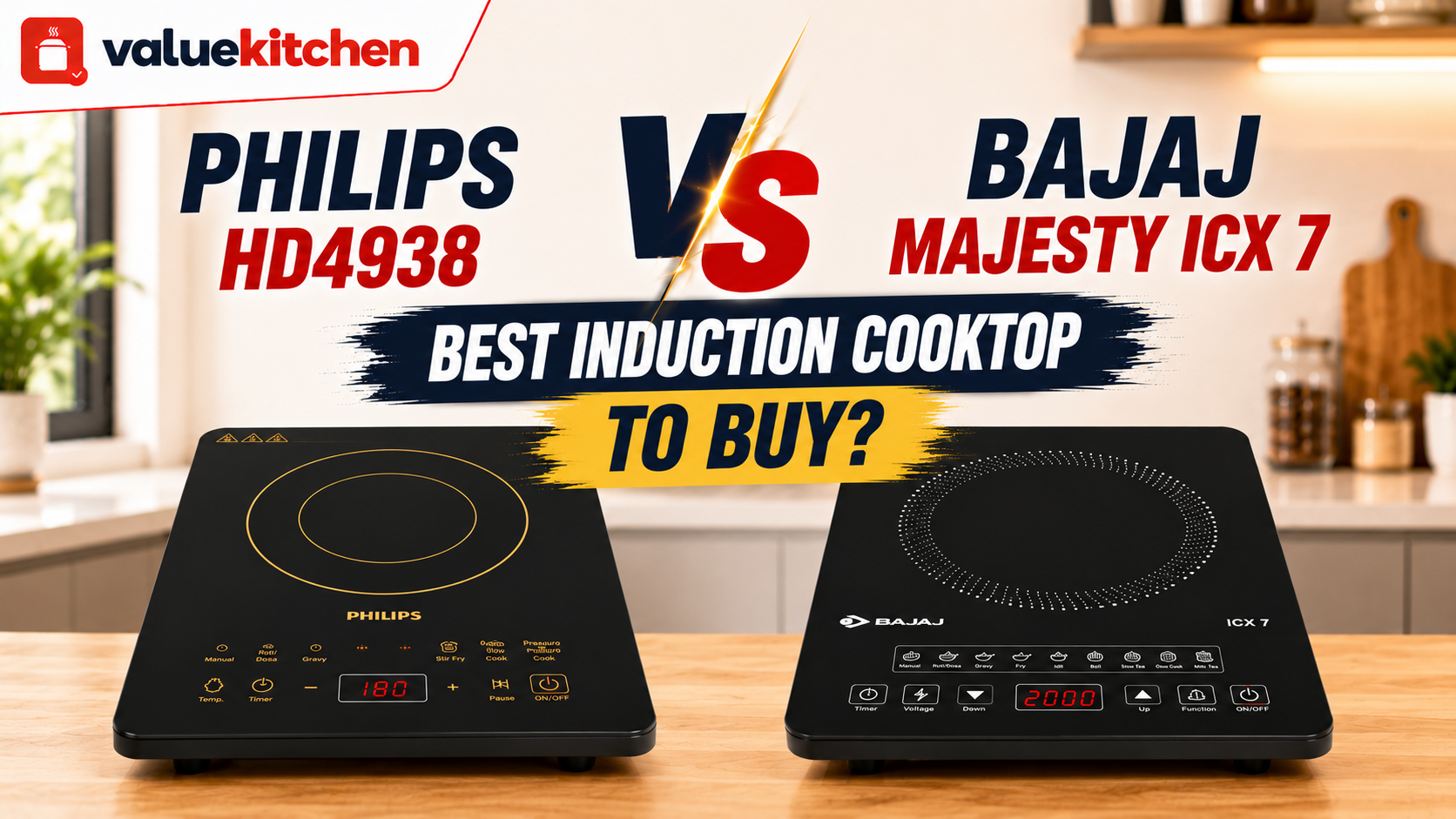
Two induction cooktops under Rs. 4,000. Same 4.2-star rating on Amazon. Completely different design choices. The Philips HD4938 gives you 2100W, sensor touch controls, and a 24-hour delayed cooking timer. The Bajaj Majesty ICX 7 gives you 1900W, push-button controls, and 8 presets at Rs. 750 less. This comparison covers power, controls, presets, timer, safety, and price, so you can pick the right one without second-guessing.
Quick Specs Comparison
| Feature | Philips HD4938 | Bajaj Majesty ICX 7 |
|---|---|---|
| Price | Rs. 3,799 | Rs. 3,049 |
| Rating | 4.2 out of 5 | 4.2 out of 5 |
| Power | 2100W | 1900W |
| Controls | Sensor touch | Push-button |
| Presets | 6 | 8 |
| Timer | 0-3 hrs + 24hr delay | 0-3 hrs only |
| Child Lock | Yes | No |
| Auto Pan Detection | Yes | Yes |
| Warranty | 1 Year | 1 Year |


Power: 2100W vs 1900W
The Philips HD4938 runs at 2100W, which is 200W more than the Bajaj Majesty ICX 7 at 1900W. In practical terms, the Philips heats a kadai or pressure cooker faster. Boiling milk, heating dal, or searing onions at peak power reaches temperature noticeably quicker.
The 1900W on the Bajaj handles everyday Indian cooking without problems. Chai, tempering, frying onions, and reheating food. All work fine. The difference shows during heavy continuous cooking, like a large batch of biryani or thick gravies that need sustained high heat.
For families cooking three meals a day on induction, the extra 200W on the Philips reduces total cooking time. For light daily use or reheating-focused households, the Bajaj 1900W is more than adequate.
Controls: Sensor Touch vs Push-Button
The Philips HD4938 uses sensor touch keys on a flat, full-glass panel. The surface is seamless, easy to wipe clean, and looks premium. The limitation is that the sensor touch sometimes misreads wet or oily fingers, which is extremely common in an Indian kitchen, mid-cooking.
The Bajaj Majesty ICX 7 uses tactile push-buttons. They click positively on every press. With wet hands, cooking gloves, or greasy fingers, push-button registers more reliably than touch sensors. The digital LED display is clear and readable from a normal standing distance.
This comes down to preference. If you clean your cooktop surface often and value aesthetics, the Philips glass panel is better. If you prioritize reliable control when your hands are not dry, the Bajaj buttons have the edge.
Presets: 6 vs 8
The Bajaj Majesty ICX 7 ships with 8 preset cooking modes covering dosa, roti, soup, fry, milk, water, slow cook, and stir fry. Each preset auto-sets the ideal temperature and power level for that task. The Philips HD4938 has 6 presets that cover the core functions but leave out some specialized modes.
For experienced cooks who adjust temperature manually, the preset count matters less. Presets are most valuable when you are new to induction cooking. The Bajaj’s 8 presets reduce the trial-and-error phase for first-time induction users, especially for Indian dishes that need specific low-temperature control, like dosa.
Timer and Scheduling
The Philips HD4938 offers two timer modes: a standard 0-3 hour cooking timer and a 24-hour delayed start function. The delayed start lets you load the cooktop with a vessel, set a future start time, and walk away. Useful for soaking and cooking lentils, starting rice before returning from work, or prepping stock overnight.
The Bajaj Majesty ICX 7 has a standard 0-3 hour countdown timer for cooking duration with no delayed start feature. If meal prep scheduling matters to you, the Bajaj does not support it.
Safety Features
The Philips HD4938 includes a child lock, auto pan detection, and auto-off when no vessel is placed. The child lock disables all buttons, preventing accidental activation. This is a meaningful safety feature in households with young children. The cool-to-touch glass surface keeps the panel from heating up directly.
The Bajaj Majesty ICX 7 has auto pan detection that shuts off if no compatible vessel is detected within one minute. Auto-off activates when the timer ends. There is no child lock on the Bajaj. Both models use a cool-to-touch polished crystal glass surface.
Price and Value
The Bajaj Majesty ICX 7 costs Rs. 3,049, which is Rs. 750 less than the Philips at Rs. 3,799. That is a meaningful gap in this price segment. The Bajaj delivers 8 presets, 1900W, reliable push-button controls, and solid build quality at a price that is hard to argue against for value buyers.
The Philips HD4938 costs more but returns more: 200W extra, sensor touch, child lock, and 24-hour scheduling. If any of those features match your use case, the Rs. 750 premium is well justified.
Winner Summary
| Category | Winner | Reason |
|---|---|---|
| Power | Philips HD4938 | 2100W vs 1900W |
| Presets | Bajaj ICX 7 | 8 presets vs 6 |
| Timer | Philips HD4938 | 24-hour delayed start feature |
| Safety | Philips HD4938 | Child lock included |
| Price | Bajaj ICX 7 | Rs. 750 cheaper |
| Warranty | Tie | 1 year on both |
Verdict
Buy the Philips HD4938 if:
- You have children at home and need a child lock
- You want to pre-schedule cooking with the 24-hour delayed start
- You cook heavy loads daily and need the extra 200W headroom
- You prefer a clean sensor touch panel over physical buttons
Buy the Bajaj Majesty ICX 7 if:
- Your budget is under Rs. 3,200, and you want maximum value
- You prefer tactile push-button controls for wet-hand reliability
- You are a first-time induction user who benefits from more preset options
- Child lock and delayed cooking are not priorities for you
Related Reading
- Best Air Fryers Under Rs. 5,000 in India (2026)
- 750W vs 1000W Mixer Grinder: Which One Should You Buy?
- Best 1000W Mixer Grinders Under Rs. 10,000 in India (2026)
Frequently Asked Questions
Is the Philips HD4938 compatible with all utensils?
No. Like all induction cooktops, the Philips HD4938 requires induction-compatible utensils with a flat magnetic base. Check the bottom of your vessel for a coil symbol. Stainless steel and cast iron work. Standard aluminium and non-stick pans do not work unless they have a dedicated induction-compatible base layer.
Does the Bajaj Majesty ICX 7 work with a pressure cooker?
Yes, the Bajaj ICX 7 works with induction-compatible pressure cookers that have a flat magnetic base. Most modern stainless steel pressure cookers from Prestige and Hawkins have induction-compatible variants. Check the product label before buying.
Can I use the 24-hour timer on the Philips HD4938 for unattended cooking?
The 24-hour delayed start on the Philips HD4938 sets a future start time. For safety, use it only for low-risk tasks like soaking lentils, starting rice, or heating dal in a covered vessel. Do not use it for high-temperature frying or open-vessel tasks that need monitoring.
Which is better for South Indian cooking?
The Bajaj Majesty ICX 7 has a dedicated dosa preset, which is a practical advantage for South Indian kitchens. The Philips HD4938 achieves the same result through manual temperature setting, but the Bajaj removes the guesswork for dosa, idli batter heating, and rasam.
How do both compare on electricity consumption?
The Philips HD4938 at 2100W uses slightly more electricity at peak than the Bajaj at 1900W. In practice, induction cooktops cycle on and off to hold temperature, so actual unit consumption is lower than peak wattage. At Rs. 8 per unit in India, an hour of cooking costs roughly Rs. 15-17 on either model. The gap in monthly electricity cost is minimal for home use.