750W vs 1000W Mixer Grinder: Which One Should You Buy for an Indian Kitchen?
Some links on this page are affiliate links. We may earn a commission at no extra cost to you.
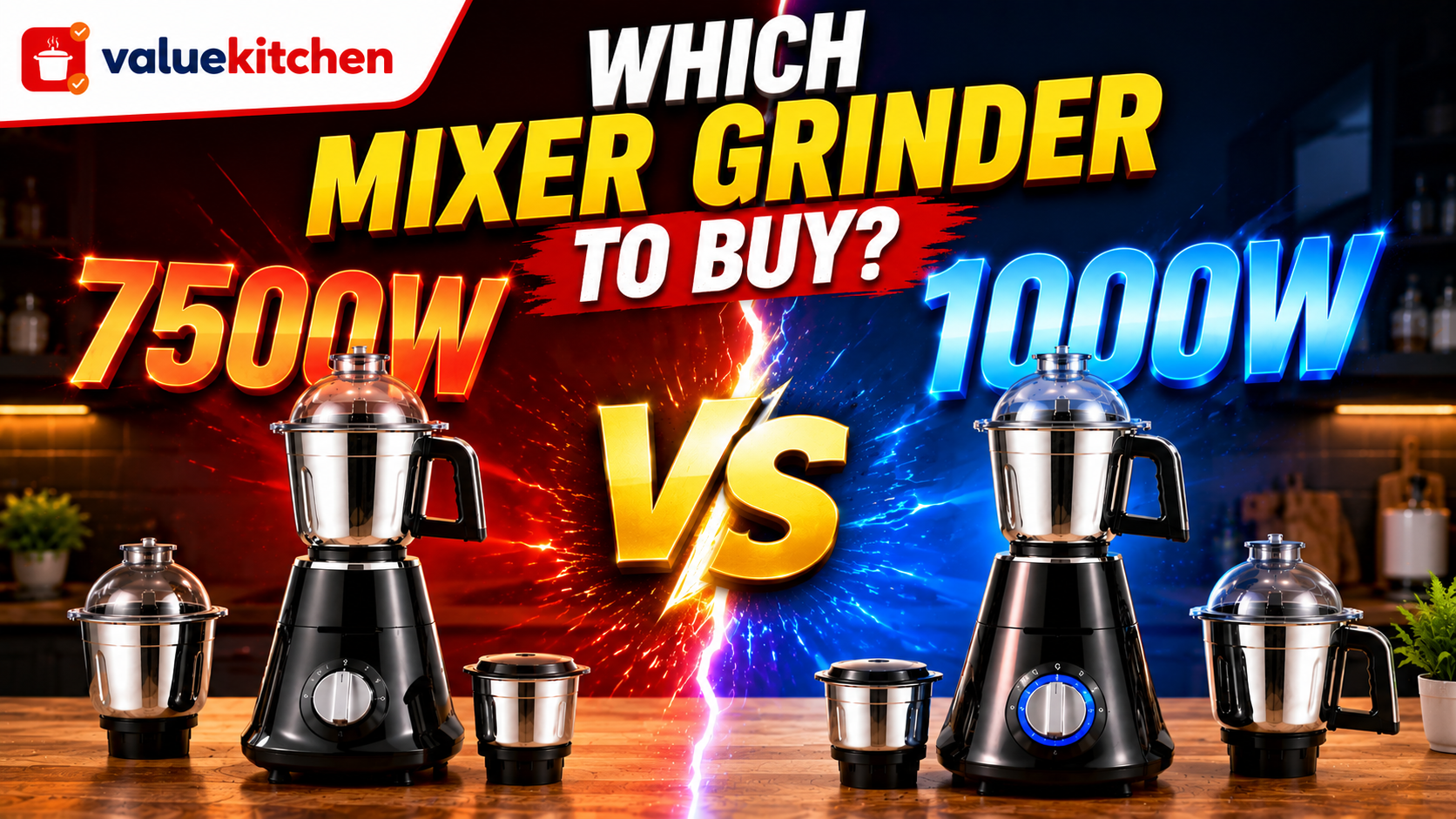
Buying a mixer grinder in India comes down to one question faster than any other: 750W or 1000W? The price difference is real, the motor difference is real, but for most buyers, the actual cooking difference is smaller than the spec sheet suggests. This guide explains exactly what wattage means for Indian cooking and which one you should buy.
Quick Answer
Buy 750W if: You cook for 2 to 4 people, grind chutneys and soft spices daily, and want to keep costs under Rs. 4,000.
Buy 1000W if: You cook for a family of 4 or more, make idli or dosa batter frequently, grind hard spices in large quantities, or run a home food business.
What Wattage Actually Means
Wattage is the power the motor draws from your electricity supply. A 750W motor draws 750 watts; a 1000W motor draws 1000 watts. In a mixer grinder, more wattage means:
- More torque at the blade, so harder ingredients grind without slowing the motor
- Better heat management during long grinding sessions
- Faster completion of tasks that need sustained power, like wet batter grinding
What wattage does NOT mean: better blades, better jar quality, or a quieter machine. A 1000W motor in a poorly built grinder still underperforms a 750W motor in a well-built one. Wattage is one factor, not the whole picture.
Head-to-Head Comparison
| Feature | 750W Mixer Grinder | 1000W Mixer Grinder |
|---|---|---|
| Motor power | 750 watts | 1000 watts |
| Grinding speed | Good for soft ingredients | Better for hard spices and tough ingredients |
| Idli/dosa batter | Works, may need breaks | Handles large batches without strain |
| Daily chutneys | Excellent | Excellent (no real difference) |
| Hard dry spices | Adequate for small quantities | Superior for large quantities |
| Continuous running | Needs breaks every 10 to 15 min | Can run 20 to 30 min continuously |
| Electricity cost | Slightly lower | Slightly higher (small difference in practice) |
| Price range | Rs. 2,500 to Rs. 5,000 | Rs. 5,000 to Rs. 10,000+ |
| Best for | Small to medium families | Large families, food businesses |
Best 750W Pick: Philips HL7756

Philips HL7756/00 750W Mixer Grinder
The most trusted 750W mixer grinder in India. Strong copper motor, nationwide Philips service centres, and proven performance for daily Indian cooking. Handles chutneys, masalas, and soft batter comfortably.
- Reliable 750W copper motor
- 36,000+ verified buyer ratings
- Philips service network across India
- 25 min continuous grinding rated
- Best value for everyday use
- Needs breaks for hard, dry spices in large quantity
- Not ideal for large batch sizes daily
- 3 jars only, no blender jar
Best 1000W Pick: Preethi Boltz

Preethi Boltz 1000W Mixer Grinder
The best value 1000W mixer grinder in India. Preethi is the No. 1 mixer grinder brand by market share, and the Boltz is their most popular everyday model with 4 jars at the lowest 1000W price point.
- 1000W motor handles large batter batches
- 4 jars, including a blender jar
- India’s No. 1 mixer grinder brand
- Best price for a 1000W model
- 10,000+ verified buyer ratings
- Costs Rs. 2,000 more than the best 750W
- Heavier and bulkier on the counter
- Higher electricity draw per session
Cost vs Value Breakdown
| Factor | 750W (Philips HL7756) | 1000W (Preethi Boltz) |
|---|---|---|
| Purchase price | Rs. 3,499 | Rs. 5,592 |
| Price difference | Rs. 2,093 more for 1000W | |
| Monthly electricity cost (30 min/day) | ~Rs. 27 | ~Rs. 36 |
| Number of jars | 3 jars | 4 jars |
| Warranty | 2 years | 2 years |
| Best use case | Daily chutneys, soft spices, small family | Batter grinding, large family, food business |
The electricity difference works out to around Rs. 9 extra per month for the 1000W model. Over a year, that is about Rs. 108. The Rs. 2,093 price gap takes roughly 20 years of electricity cost difference to offset, which means the price premium is entirely about motor capacity, not running costs.
Verdict
Choose 750W if you cook for 2 to 4 people, and your daily grinding is chutneys, soft masalas, and occasional small batches of batter. The Philips HL7756 at Rs. 3,499 handles this perfectly and comes from the most trusted service network in India.
Choose 1000W if you cook for a family of 4 or more, make idli or dosa batter regularly, grind large quantities of dry spices, or operate a home tiffin service. The Preethi Boltz at Rs. 5,592 gives you 1000W performance at the lowest price in the segment with 4 jars included.
For a full breakdown of 750W options, see our best mixer grinder under Rs. 5,000 guide. For more 1000W options, see our best 1000W mixer grinders under Rs. 10,000.
Which Wattage for Different Indian Cooking Tasks
| Cooking Task | 750W | 1000W |
|---|---|---|
| Daily coconut chutney (small batch) | Excellent | No real difference |
| Ginger-garlic-onion paste | Excellent | No real difference |
| Idli-dosa batter for 2 people | Works with one break | Better, no break needed |
| Idli-dosa batter for 4+ people daily | Needs 2 grinding cycles | Recommended |
| Dry red chilli powder (500g batch) | Adequate with rest | Better, single session |
| Sambar powder grinding (large batch) | Needs rest between cycles | Single uninterrupted session |
| Fresh coconut grinding | Yes | No difference |
| Smoothies and milkshakes | Yes (if blender jar included) | No difference |
Motor Stress and Long-Term Durability
This is the factor most buyers overlook. A 750W motor working near its thermal limit on a large batter batch every morning generates more heat stress than a 1000W motor handling the same task comfortably within its capacity. Running a 750W motor at maximum load 5 to 7 days a week shortens motor life faster than a 1000W motor doing the same work with headroom to spare.
Both motors typically carry 2-year warranty coverage. But the 1000W motor is less likely to need servicing from motor strain during the warranty period when used for heavy daily grinding. For households that grind batter almost every day, the 1000W motor is the more durable long-term investment even if the upfront cost is higher.
Noise: Does Wattage Change Anything?
Higher wattage does not mean louder operation. Noise in a mixer grinder depends on blade design, jar quality, the density of the ingredient being ground, and how well the motor is mounted inside the body housing. A high-quality 750W motor in a well-built unit can be quieter than a low-quality 1000W motor from a cheaper brand. If noise in early mornings or late evenings matters, read buyer reviews for your specific shortlisted model and look for explicit mentions of noise levels rather than assuming wattage determines loudness.
Electricity Cost: The Real Numbers
Running a 750W mixer grinder for 30 minutes daily uses about 0.375 kWh per day. At Rs. 6 per unit (a mid-range Indian electricity rate), this costs roughly Rs. 2.25 per day, or about Rs. 67 per month. A 1000W motor for the same 30 minutes consumes 0.5 kWh per day, costing Rs. 3 per day, or Rs. 90 per month.
The extra electricity cost of a 1000W motor over 750W is approximately Rs. 23 per month, or Rs. 276 per year. Over 5 years, that is Rs. 1,380 in additional electricity. Given that the price gap between a quality 750W model and a quality 1000W model is typically Rs. 2,000 or more, electricity savings from choosing 750W do not offset the price difference in the long run. The choice between 750W and 1000W is about cooking performance, not electricity bills.
Frequently Asked Questions
Is 750W enough for idli dosa batter?
For small quantities (1 to 2 cups of dal and rice), 750W is sufficient. For large families making batter daily in 4 to 6 cup quantities, 1000W handles it better with fewer breaks and more consistent grinding. A 750W motor grinding a large batter batch may overheat and need a 5 to 10 minute cooling break mid-session.
Does a 1000W mixer grinder consume a lot more electricity?
In practice, no. A 1000W grinder running 30 minutes daily uses about 0.5 units of electricity per month more than a 750W one. At standard Indian electricity rates, the cost difference is around Rs. 8 to Rs. 12 per month, which is negligible for most households.
Which is quieter, 750W or 1000W?
Wattage does not directly determine noise level. Noise depends on blade design, jar quality, motor mounting, and build quality. A well-built 1000W model can be quieter than a poorly built 750W one. Both categories have noisy and quieter options depending on the specific model.
Can a 750W mixer grinder grind dry spices?
Yes, for everyday quantities. A 750W mixer grinder handles small quantities of dry spices like coriander, cumin, pepper, and dried chillies well. For grinding large 500g+ batches of hard spices regularly, 1000W is more practical and puts less strain on the motor over time.
Which brand is best for mixer grinders in India?
Preethi is India’s No. 1 mixer grinder brand according to market research. Philips has the strongest service network with centres in most cities. Sujata is known for commercial-grade motor durability. Bajaj offers the most affordable options. The best brand depends on your priority: price, service network, or motor longevity.
Comparing specific models? Read our Preethi Boltz 1000W vs Philips HL7703 1000W comparison or the Philips HL7756 vs Preethi Blue Leaf Diamond head-to-head for 750W model recommendations. Also check our guide on 5 quick Indian chutneys you can make in a mixer grinder in 5 minutes.