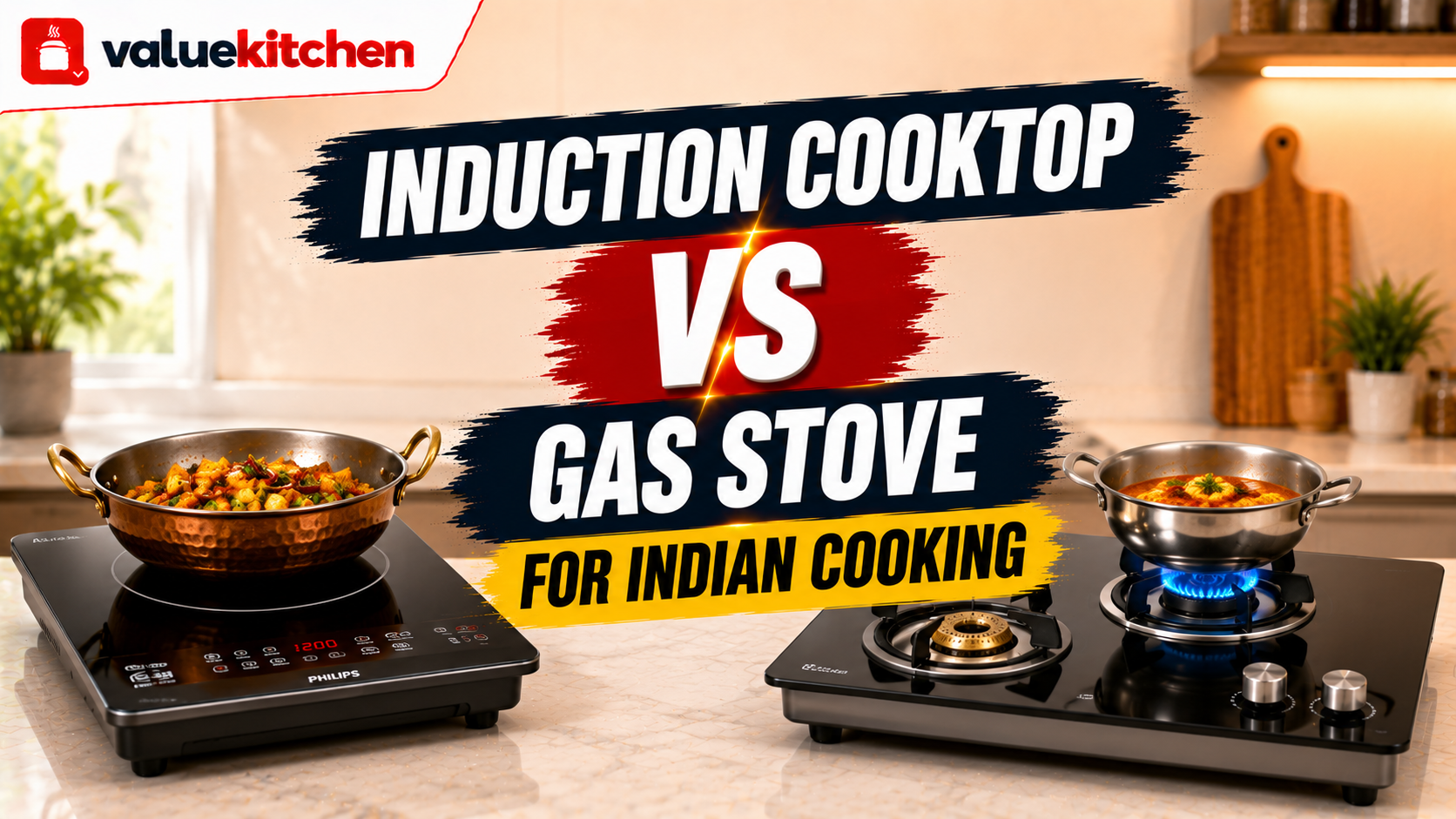
Induction Cooktop vs Gas Stove: Which Is Better for Indian Cooking?
Induction cooktop or gas stove? This debate comes up in almost every Indian kitchen upgrade conversation, and both sides have valid points.
The answer depends on how you cook, what you cook, where you live, and how often your power goes out. This guide gives you a complete comparison across every factor that matters so you can decide confidently for your own kitchen.
How Each Works
Gas stove: Burns LPG from a cylinder to create a visible flame. The flame heats the bottom of your vessel through direct contact and radiated heat. The cooktop surface itself does not heat up on its own. Works completely independently of electricity.
Induction cooktop: Uses electromagnetic induction to generate heat directly inside the base of your cooking vessel. The cooktop surface stays relatively cool during cooking. Only cookware with a magnetic base heats up. Runs on standard household electricity.
Cooking Speed
Induction is faster for most everyday kitchen tasks. A standard 2000W induction cooktop brings one litre of water to a boil in about 4 to 5 minutes. A gas burner on medium flame takes 7 to 9 minutes for the same task.
The speed advantage shows clearly in these tasks:
- Boiling water for tea, coffee, and rice
- Heating milk
- Pressure cooking dals and gravies
- Deep frying where oil needs to reach temperature quickly
Gas holds the edge for direct-flame cooking. Charring vegetables for baingan ka bharta, puffing phulkas on the burner, and getting that smoky flavour in a tadka are things induction cannot replicate. These techniques need a real flame.
Energy Efficiency and Monthly Running Cost
Induction cooktops convert 85 to 90 percent of their electrical energy into heat inside the vessel. Gas stoves are 40 to 55 percent efficient, meaning nearly half the heat from the burning LPG escapes around the vessel and warms your kitchen instead of your food.
| Factor | Gas Stove | Induction Cooktop |
|---|---|---|
| Thermal efficiency | 40 to 55% | 85 to 90% |
| Monthly fuel cost (3 to 4 member household) | Rs. 800 to Rs. 1,200 (LPG refill) | Rs. 200 to Rs. 450 (electricity) |
| Kitchen heat generated | High (warms the room) | Low (surface stays cool) |
| Estimated 5-year running cost | Rs. 48,000 to Rs. 72,000 | Rs. 12,000 to Rs. 27,000 |
These are estimates based on average daily cooking in a typical Indian household. Actual costs depend on your state electricity tariff and local LPG refill prices, both of which vary significantly across India.
Safety
Induction is considerably safer, especially in households with young children or elderly family members.
Gas stove risks include: open flame near clothing or loose material, gas leaks from cylinder connections, accidentally leaving a burner on, and the general hazard of an exposed flame in a home with children.
Induction safety advantages: The glass surface only heats the area directly under the cooking vessel. Touch the surface next to a hot pan and it feels barely warm. Most induction cooktops include automatic shut-off when you remove the vessel, built-in timers, and child safety locks.
Indian Cooking Compatibility
This is where gas holds a genuine and significant edge. Traditional Indian cooking depends on direct flame for many key techniques.
What gas does that induction cannot:
- Charring vegetables directly on the flame (baingan ka bharta, roasted tomatoes and green chillies)
- Puffing phulkas and chapatis directly on the burner
- Getting a smoky flavour in tadka and tempering
- Using traditional clay pots, old copper vessels, or standard aluminium cookware
What induction handles well for Indian cooking:
- Pressure cooking dals, rajma, chole, and rice
- Boiling milk and making tea
- Deep frying with precise temperature control (samosas, pakoras, puris)
- Slow simmering of gravies, kormas, and butter chicken
- Making kheer, halwa, and other milk-based sweets requiring consistent low heat
- Making rotis on an induction-compatible iron tawa
Cookware Compatibility
This is the most practical factor to check before switching to induction.
Induction cooktops only work with cookware that has a magnetic base. This includes cast iron, most stainless steel, and non-stick pans marked as induction-compatible. Pure aluminium, copper, glass, and ceramic vessels do not work on induction.
In most Indian kitchens, the aluminium pressure cooker and traditional copper or aluminium vessels are not compatible with induction. If your kitchen has many of these, you either need to keep the gas stove or budget for replacing key cookware pieces before switching to induction.
Upfront Cost and Maintenance
| Category | Gas Stove | Induction Cooktop |
|---|---|---|
| Entry price (2-burner / single zone) | Rs. 1,500 to Rs. 3,500 | Rs. 1,500 to Rs. 4,000 |
| Mid-range (3 to 4 burners) | Rs. 3,000 to Rs. 12,000 | Rs. 4,000 to Rs. 15,000 |
| Extra cookware needed | None | Rs. 1,500 to Rs. 4,000 if existing vessels are non-magnetic |
| Maintenance | Moderate (burner unclogging, tube checks) | Easy (wipe glass surface only) |
| Service network in India | Very wide | Good for major brands (Philips, Prestige) |
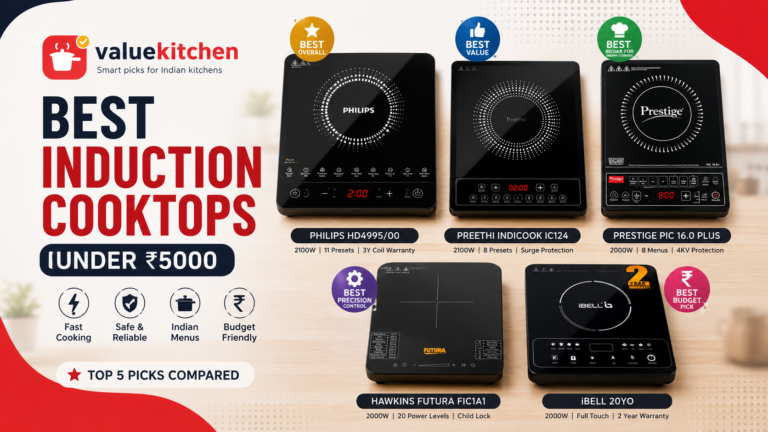
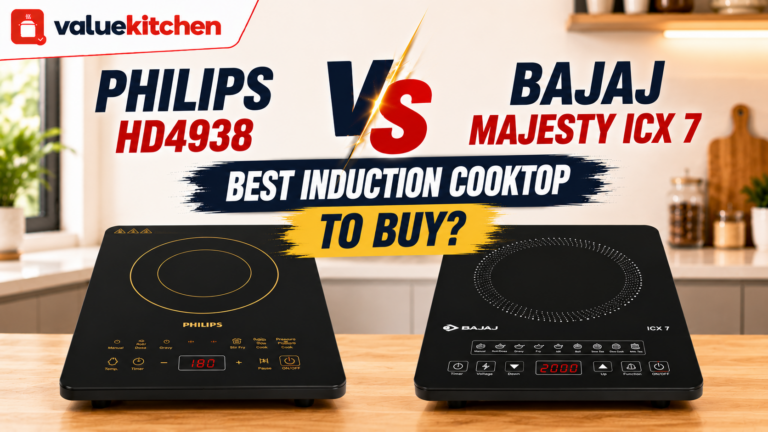
For gas stoves, Prestige, Sunflame, and Elica are the most service-friendly brands in India. For induction cooktops, Philips and Prestige have the widest service networks. Read our Philips vs Bajaj induction cooktop comparison for a detailed breakdown of two popular models.
Performance During Power Cuts
This is a non-negotiable factor in many parts of India, especially in smaller towns and during the monsoon season when outages are frequent and unpredictable.
Induction cooktops stop working the moment power goes out. If you are mid-cook, that creates a real problem.
Gas stoves with manual ignition work completely independently of electricity. Even auto-ignition models only need electricity for the spark. Once the flame is lit, it continues through any power cut without interruption.
Final Verdict: Induction Cooktop vs Gas Stove
| Category | Gas Stove | Induction |
|---|---|---|
| Cooking speed (general tasks) | Good | Better |
| Monthly running cost | Higher | Lower |
| Safety | Moderate | High |
| Traditional Indian cooking | Excellent | Good |
| Works with all vessels | Yes | No (magnetic base only) |
| Works during power cuts | Yes | No |
| Upfront cost | Lower | Moderate |
| Maintenance | Moderate | Easy |
Choose a gas stove if you cook traditional Indian food daily, face frequent power cuts, or have many non-magnetic vessels you are not ready to replace.
Choose induction if safety is your top priority, you want to cut monthly fuel costs significantly, or your cooking is mostly pressure cooking, simmering, and frying.
Best setup for most Indian households: Keep a gas stove as the primary cooktop for traditional Indian cooking, and add a single-zone induction cooktop (available under Rs. 2,000) for faster everyday tasks. Using both is financially practical given how low induction running costs are.
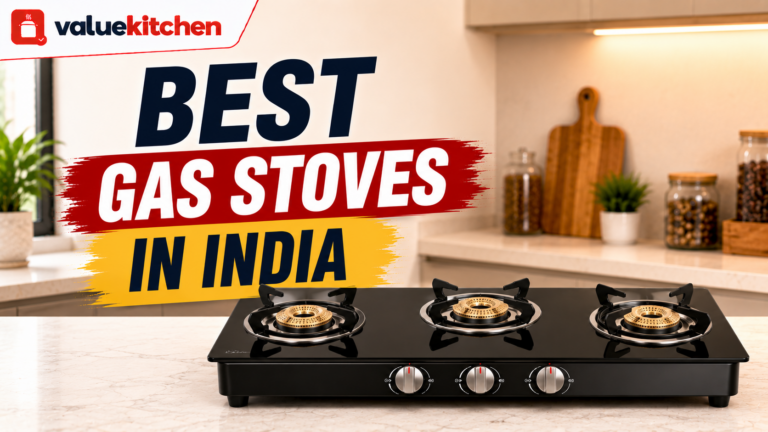
If you are deciding on a gas stove, read our guide to the best gas stoves in India 2026 covering top picks across 2-burner, 3-burner, and 4-burner categories.
Frequently Asked Questions
Can I use my regular aluminium pressure cooker on an induction cooktop?
Traditional aluminium pressure cookers are not magnetic, so they do not work on induction. Check with a fridge magnet. If it sticks to the bottom of the cooker, it is induction-compatible. If not, you need a stainless steel or cast iron pressure cooker. Brands like Prestige and Hawkins both sell induction-compatible models designed for Indian cooking.
Does an induction cooktop increase electricity bills significantly?
Not significantly. A 2000W induction cooktop running for one hour uses 2 units of electricity. At Rs. 6 to Rs. 8 per unit (typical Indian residential tariff), that is Rs. 12 to Rs. 16 per hour of cooking. Most daily cooking tasks take 20 to 40 minutes total, so actual daily induction costs are Rs. 10 to Rs. 25 for a family of four, which is lower than a single day’s LPG usage.
Can I make rotis on an induction cooktop?
You can make rotis on a tawa placed on an induction cooktop, provided the tawa is induction-compatible (cast iron or with a magnetic base). However, you cannot puff phulkas directly over the flame the way you can on a gas burner. If soft puffed rotis are a daily requirement, a gas stove remains the better tool for that specific task.
Is induction cooking safe for health?
Yes. The electromagnetic fields from induction cooktops are low-frequency and localised to the cooking zone directly under the vessel. They do not emit radiation beyond the cooking area. Induction cooking also produces no combustion gases or carbon monoxide, which gas stoves produce in small amounts — this is a meaningful benefit in closed kitchens with limited ventilation.
Which induction cooktop brand is best in India?
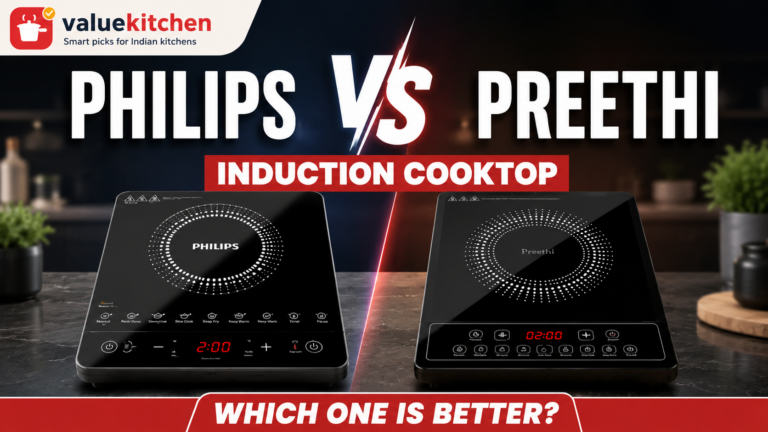
Philips, Prestige, and Bajaj are the most reliable induction cooktop brands in India based on after-sales service availability and long-term reliability. Philips models tend to have the most consistent temperature control for simmering tasks. Read our detailed Philips vs Bajaj induction cooktop comparison for a full breakdown of two popular models.
How long does an induction cooktop last?
A good quality induction cooktop lasts 5 to 8 years with normal use and care. The glass-ceramic cooking surface is durable but can crack if a heavy vessel is dropped on it. Avoid sliding cookware across the glass surface and clean with a soft damp cloth only. Never use abrasive cleaners on the glass.
Efficiency and cost estimates are based on publicly available appliance specifications and average Indian residential electricity and LPG tariff data as of 2026. Actual costs vary by region and household usage pattern. This is an independent editorial guide with no affiliate links.